
15 Years of Running Burrow Press
some thoughts and lessons

While I made this Substack to focus on my own writing/practice, I’ve been running a small literary press, Burrow Press, for 15 years, and when you do something that long, it’s probably worth writing about. A version of this essay will appear on the Asterism Books blog next month. Asterism is Burrow’s distributor (as well as the distro for many other amazing presses) so you should check their site out and do some shopping. You’ll find a lot of hidden gems there. As for this version of the essay, I’m including footnotes to thank people (mostly Orlandoans) who have helped Burrow along the way. The local list is already long; if I tried to include people nationwide we’d be here all day. Apologies in advance to those who did not get nod. 15 years is a long time — and I’ve got some bookstore outreach I need to be doing for the next Burrow book — but here’s to 15 more!
Some Lessons & Reflections from 15 Years of Running Burrow Press
Have a plan, or don’t.
In 2010, when I co-founded Burrow Press with Jana Waring, we just wanted to meet other writers in Orlando and Florida. Starting a press was, for sure, an excessive means to this end. But our first book, an anthology of short stories by Florida writers, while not the sharpest theme for an anthology, did the job of introducing us to a ton of local fiction writers. When we held a book launch for the anthology, those writers brought their friends, who were also writers. Many of these people probably knew more about what a small press was than Jana and I, but the point is, this party showed us just how interested our local community was in literature. One guest wanted to do a reading series (which we helped launch, and it ran for about 5 years)1. Another guest pitched an idea for a hyper-local anthology (which would become Burrow’s second book)2. Several people expressed an interest in writing book reviews and other columns (which we housed on our blog, which eventually became our online lit mag)3. While we didn’t begin with a clear vision or plan, our mission found us. I usually tell people interested in starting a press to do a lot of research and planning. That said, Burrow probably wouldn’t exist if we had thought too much about it, if we didn’t throw caution to the wind and say: let’s fucking do this!
Tap into the power of the local.
As mentioned above, we did this by accident, but it quickly became clear that helping build a literary community was good for everyone. When Jana moved to Los Angeles after the first two years and I inherited the press, Julia Young was there to give Burrow a home under her 501c3 literacy nonprofit, so the press could fundraise for our next book and generally have a chance at growing.
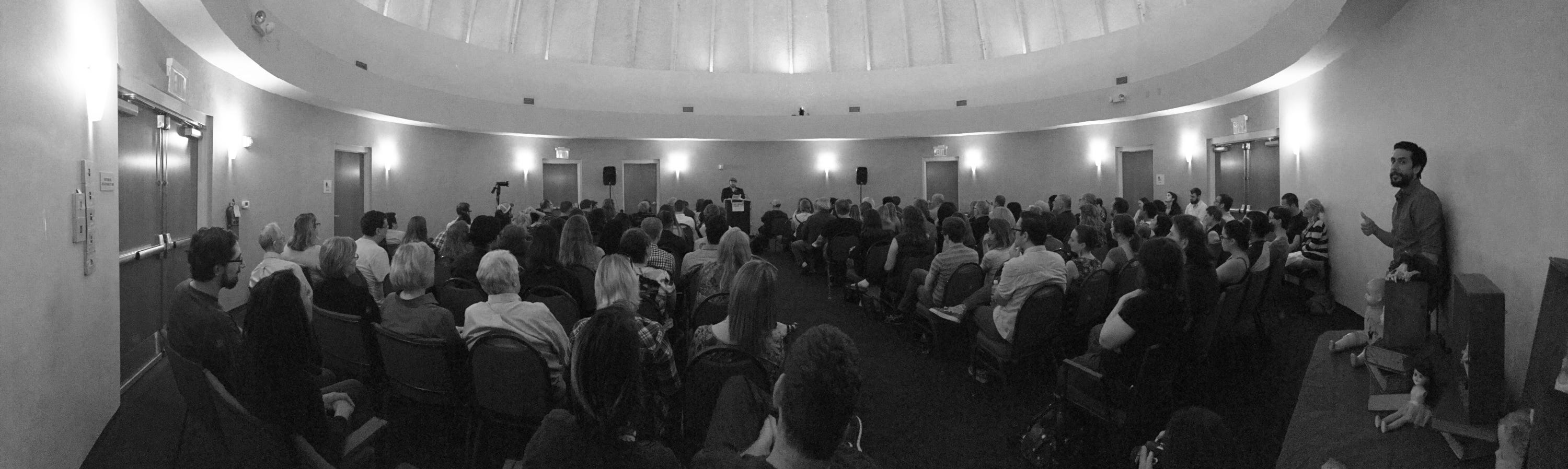
Eventually Burrow branched out beyond the local, but we still have incredible hometown support that has sustained us for 15 years. People who are not only our dedicated readers4, but who have contributed to Burrow as editors5 and event hosts6, book cover artists7 and designers8, venues9 who’ve donated event space, colleges and universities who’ve invited Burrow into classrooms10, not to mention the local collage radio station, WPRK, that let me and writer Jared Silvia (who I published in that very first anthology) host a literary radio show for a while.
Ask for help; help others.
When it came time for Burrow to expand beyond the local and start publishing books regularly with the intent of landing them in bookstores and libraries, I could not have done it without the help of other small press publishers, who I simply took a chance on reaching out to and asking for advice. Two great helps were Zach Dodson, then of Featherproof, and Dan Wickett, then of Dzanc.11 The literary world is small and, I think, kind and generous for the most part. I try to pay this generosity forward to folks looking to publish or start their own small press.
Bigger is not always better.
I also researched what the “big 5” publishers do. Using them as a model was helpful in some ways, like investing in ARC printing and working on long lead times, but not in others. I’m glad, for instance, that Burrow has stuck to publishing only 3-4 books per year. Unlike at larger publishers, no Burrow author is getting lost in the midlist. Staying small has some disadvantages in terms of growth, but it does allow you to invest more time and money into each book and author. At the end of the day, even with all the resources in the world, some books just don’t hit. Success can be a crapshoot, but most of us do this work because we love it.
Publishing is personal.
This work can yield lots of friendships. Some collegial, others life-long12. Maybe it helps that I am also a writer, and so as editor/publisher I try to treat authors how I would want to be treated. Every time good news arrives for a book – a review or a blurb or whatever – I feel a vicarious joy, as if the book I’ve published is my own. I also get bummed when a book, despite best efforts, doesn’t get the attention it deserves. Reaching out to media13 and booksellers, for example, comes with its own kind of rejection (or no reply at all, a.k.a. the void) that can be akin to the rejection writers face in pursuit of getting published. For better or worse, I’m emotionally invested in these books.
Publishing felt personal from the jump, but not in the way I eventually came to understand it, at least for Burrow, where I’m the only full-time employee. After a decade or so I began to realize publishing books has been a form of personal expression. If there is any unifying theme to Burrow’s eclectic catalog, it’s that every book is a book I love. And though I often slip into the royal “we” when talking about Burrow, I’ve had to accept the strange truth that, despite relying on help from others, I am Burrow and Burrow is me.
“You have to learn how to die, if you wanna wanna be alive.” (Wilco, or Martin Heidegger)
In 2020, it looked like Burrow was on the brink of folding due to pandemic-related bullshit. We could fulfill our commitments to the authors we agreed to publish that year, but after that, there was the possibility of calling it quits. The pandemic put things into perspective. Ten years was a good run, I told myself. I spent several months in a kind of preemptive mourning, imagining life after Burrow Press. But thanks to the efforts of Teresa Carmody and Terri Witek (the power of the local!), I was able to move Burrow to a stable home at Stetson University in the fall of 2020.
To be honest, prior to the pandemic, I was in the early stages of burnout. The part where you can function just fine, but nothing feels good. Between publishing books and the online journal, organizing a quarterly reading series and other author events (plus all the microtasks therein), I could sense the joy of this work yielding ever-diminishing returns. I would often beat back this feeling with a kind of self-scolding: “you are doing what you love, so you don’t get to feel bad!” But this “near-death” experience in early 2020 was an occasion to re-assess, re-prioritize, and re-vision. It has actually been an ongoing process these past five years. I’ve given myself the space to slow down and, alas, plan. To think about Burrow’s strengths and where it might best fit into the small press landscape for another 15 years.
Find your niche.
And so, as I look ahead, I’m taking my own advice and leaving the eclecticism to my own fiction writing, while focusing Burrow’s efforts on being a home for certain types of work for which there are not currently an abundance of outlets. From now on, with the occasional exception (because I’m only human), Burrow will focus on two different series. The first is the Affordable Collaborative Artist Book series, which will launch with 3 titles in 2026. These are essentially commissions for one visual artist and one writer to collaborate on a project of their choosing within the confines of a 6x8 book. I am both excited and terrified by the fact that these projects are mostly out of my control. The other series, still in development, will be for fictions that fall somewhere between a very long short story and a very short novella – or, as the rest of the world calls them, novels.
Publishing is political.
For a very long time it was important to me (as it is to most authors) that Burrow books be available on every possible platform, including the one named after a rainforest and owned by a subpar Bond villain. Between Amazon and Ingram, the latter being what most bookstores would use to stock our books, our scale prevented us from doing much more than breaking even on books sold via those platforms. Granted, both platforms are accessible and convenient, especially for a press just starting out. But I’m done with them.
Burrow books published from 2026 and on will not be available on Amazon, nor to booksellers via Ingram. This is only possible because of our current distributor, Asterism Books, a wholesale platform by and for small presses founded by Josh Rothes. They came along and took us in at a time when I was completely over the whole distribution system. But their model is a counter to the busted old modes of yore, where booksellers buy 10 copies of a book and return 8, much to the determent of the publisher’s bottom line. I’m grateful for the ability to connect with booksellers in a more ethical way while also shrugging off our corporate overlords.
Publishing is very serious.
Because I am a serious person, I will leave you with some very important advice. Do not name your press something that might eventually become a famous athlete’s name. Case in point: I’ve had a Google news alert for “Burrow Press” from the very beginning. Some time, several years ago, a football player named Joe Burrow hit the scene. He is apparently a big deal, because at least once a week, especially in the fall, there seems to be a “Joe Burrow Press conference.” I know about them all now. It’s very annoying.
But seriously. If there’s one thing that has kept this train chugging along for 15 years, it’s that I take literature seriously, I take my job seriously, but I don’t take myself too seriously. We’ve all met that person, in publishing or elsewhere. That very serious person who is so serious as to appear, somehow, unserious. This is another way of saying: work hard, have fun. As with any creative endeavor, despite the roadblocks and hardships, if you’re not having fun, you’re doing it wrong.14
That would be Jesse Bradley and There Will Be Words. We were all so excited for a prose reading series (no shade to the poets) that we hand made limited edition chapbooks EVERY month, featuring the exact piece a person was reading so the audience could read along. The cover stock came from free paper samples requested from French Paper Co (a small press DIY lesson if there ever was one).
That would be Nathan Holic’s brainchild “15 Views of Orlando,” of which we did three volumes, plus one for Tampa, one for Miami, and a sanctioned Jacksonville edition by Bridge Eight Press.
Nate was also on the blog. He had just become a dad and wrote a book review column called “Reading Books While Burping My Baby.” Jared Silvia and Gene Abamonte had random humor columns. Ian If wrote “Parables of America.” Rachel Kapitan had a review column in which she attempted to review all the Penguin Modern Classics. The blog became Burrow Press Review and could only have existed because of Hunter Choate (founding Fiction Editor) and Susan Fallows (founding nonfiction editor). Brianna Johnson was a longtime Managing Editor. The Review has probably had the most people come through as Burrow helpers. Ben Gwin was Fiction Editor at one point, and Breanna Cummings for a brief period amid the weird pandemic days of 2020. Plus so-many guest editors, including Erica Dawson, Susan Lilley, Jamie Poissant, Teege Braune, Yuki Jackson, Bre’Anna Bivens, Lucianna Chixaro Ramos, Chad B. Anderson, Nicholas Russell, Ariel Francisco… I’m definitely leaving people out. Arg!
Shoutout to Marcella and Ryan at Whatever Tees, who were subscribers from the beginning and whose company printed our 15-year anniversary totes!
Editorial assistance these days is coming from Bre’Anna Bivens and Alex Gurtis. I name most of the BP Review editors already.
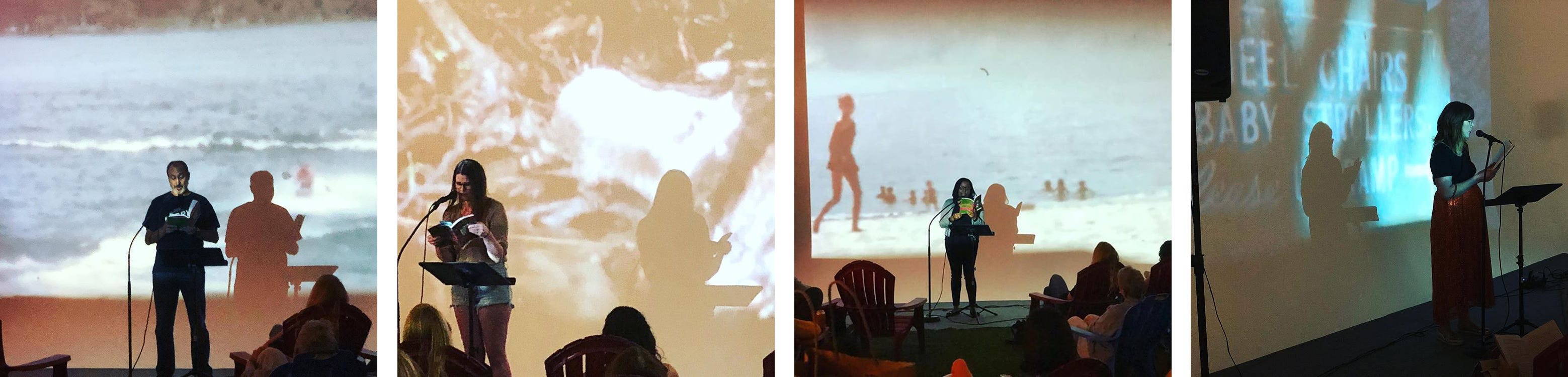
This mainly refer to Jared Silvia, the one and only host of the Functionally Literate Reading Series, which saw so many great authors pass through Orlando. Jared also hosted the Functionally Literate Radio show with me for a couple years. Jared also made sure the audio/visuals of all our events were on point. I should also say both Jon Kosik (a writer, among other things) and Mike Wheaton (now the Publisher of Autofocus Books) put time in behind the camera when we recorded these events. Jon also helped film a book trailer or two. My former co-workers at the literacy nonprofit were often working the cash bar at these events, so shoutout to Michelle Riddle and Phil Zoshack. Various reps from Park Ave CDs and Kim Britt’s microbookstore Bookmark It (RIP) would often be there selling the visiting writers’ books. Local lit pillar John King would often interview writers coming through (and also Burrow writers) for his long-running Drunken Odyssey podcast. Another literary pillar in general, Racquel Henry, moderated our first ever YA-themed Functionally Literate event. And thanks to writer Usman Malik (a Func Lit alum himself), the series partnered with the Salam Award for Imaginitve Fiction to bring a fantastic writer from Pakistan. Other notable partnerships included Watermark, Housewifes Collective, and — kind of randomly — Yelp Orlando (managed by Andi Perez at the time, and at that time people actually did look for events on Yelp).
Kira Gondeck-Silvia probably wins the award for most involvement in Burrow book covers. But so many local Orlando folks have contributed their work over the years to make some killer covers: Brian Phillips, Plinio Pinto, Amy Wheaton, Boy Kong, Alex Lenhoff, John Hurst, and Sean Walsh (Secret Society Goods).
Tina Craig designed our very first book, and so many to follow (including the TWBW chapbooks). She taught me everything she knows before she got sick of working for basically free. Liesl Swogger also did a stint as a Burrow book designer in 2016-17-ish, and Andrea Penuela is currently helping with some cool designs you’ll see very soon. Small press lesson #538: find a friend who is a good designer and learn from them.
So many great people/venues have given us space for little to nothing: Benoit at Timucua is a long-time partner, Matt and Mary at The Nook on Robinson (where our 15-year party is happening). Sarah at the downtown library. Chris at Blue Bamboo. Julio at Orange Studio. Ben at the long-defunct Brookhaven warehouse (a space that I don’t think had a proper name), also the Shakes, the Kerouac House, Zeppelin Books (RIP), and Maitland Art Center. Pat Greene for many things but specifically two collab events we did at the Gallery at Avalon Island. Most recently we had a killer event on the patio at Kaya.
I don’t know how many times I spoke in front of Laurrie Uttich’s auditorium of creative writing undergrads, but I do know that one of them was Alex Gurtis, a good friend and current Orlando lit pillar.
A huge thanks is also owed to Curtis Michelson. Not a publisher but a friend and consultant who helped me move Burrow into its new phase.
I’ve named a lot of them already, Shane Hinton is another. A dude who I’ve tried to get to find an agent but who refuses to publish with anyone else. It’s a whole other post to talk about this, a small press parable.
For as long as Burrow has been around Jessica Bryce Young (and for a shorter time Matthew Moyer) at Orlando Weekly have been so incredibly supportive with their coverage of our books and events. Matt Palm at the Sentinel and Brendan O’Connor, formerly of Bungalower (now running Orlando Shine) have often come through with a nice piece as well. My god I just remembered Tod Caviness (an Orlando lit pillar in his own right) wrote for the Sentinel, too. Matthew Peddie at the local NPR (give them money!) had me and other Burrow folks on the air so many times. Michael McLeod for Orlando Magazine. And of course Nick Georgoudiou for The Community Paper.
Also: shout out to Heather Halak, propeitrix of Third House Books, who started as a covid pen pal and eventually spent some time running Burrow’s socials and, most importantly, reminding my curmudgeon ass that Burrow does things worth posting about.
I am definitely forgetting people and I am sorry!!!!!
Looking forward to another 15 years. Burrow Press was instrumental in my early writing days. Through publications, events, and friendships that carried us to late night tacos and beers after readings, I found so much confidence in what I was trying to do in the Orlando lit scene(I was learning how to navigate a paragraph and understand what exactly a lit scene was). AWP in Boston and Chicago with the Burrow Press crew was indeed a delight. I've not found a group like our Orlando scene since moving to Nashville. It's something I miss tremendously. You've done amazing work, Ryan.
Thank you for Burrow Press—truly one of the most exciting presses I've encountered.